
Wrongful Death Cases in Georgia: Frequently Asked Questions
Georgia’s wrongful death law has been called the “noblest statute in Georgia.” It values life highly. In Georgia, where a person or entity takes somebody’s life, the party at fault must pay “the full value of the life.” O.C.G.A. § 51-4-2(a). In one wrongful death case we handled, the jury returned a verdict of $150,000,000.
If you are reading this page because you have lost a loved one or a close friend, we offer our condolences. We hope this page will help answer questions.
Yes, plaintiffs can still have wrongful death claims when the decedent was undocumented. However, there are some challenges with wrongful death claims if the victim was undocumented.
- Proving Lost Wages: Demonstrating lost wages could be more difficult, particularly if the decedent did not submit regular tax filings.
- Bias or Discrimination: In certain cases, the defendant or court could potentially hold a biased view about the decedent's immigration status. This may impact any potential settlement offers.
- Fear of Deportation: Family members may be reluctant to file wrongful death claims if they are also undocumented.
Yes, plaintiffs are able to bring wrongful death claims that were the result of medical malpractice in Georgia. There are a number of different actions in a medical setting that could give rise to a wrongful death claim. A doctor may have failed to diagnose a person's illness. In other situations, a physician may have killed a patient by giving them the incorrect dosage of anesthesia or some other medication.
Not every adverse outcome in a medical setting will give rise to a wrongful death claim. Medical malpractice occurs when there is a deviation in the acceptable standard of care. For example, doctors have a legal obligation to wash their hands prior to a surgery. When a doctor fails to wash their hands, they put patients at risk of contracting serious infections. No reasonable doctor about to perform a surgery would fail to wash their hands and disinfect beforehand.
You can file a wrongful death claim against government agencies in Georgia. However, there are a number of rules and deadlines that must be observed. For example, the plaintiff must file a specific notice letter with the governmental agency within 12 months. There are also a number of situations where Georgia government entities have sovereign immunity from wrongful death claims. It is important to work with an attorney if a government entity in Georgia is responsible for a wrongful death. They can let you know what your legal options are.
Yes, several parties could potentially be held liable for any wrongful death case in Georgia. This is commonly referred to as “joint and several liability.” Here are some common examples of cases where there could be multiple liable parties.
- Car Accidents: A driver and vehicle manufacturer could potentially be liable for a collision, provided that there was some type of defect with a car that caused the crash.
- Medical Malpractice: A physician and hospital could potentially be liable for any incident of medical malpractice.
- Workplace Accidents: Workers will typically be able to recover through George's workers compensation system. They may also be able to recover through a third-party liability claim. For example, a third-party contractor could be liable for a worker’s injuries if it was caused by their failure to maintain safety standards.
- Defective Products: When consumers are injured by faulty products, the manufacturer and the retailer of the product could both bear some liability.
- Premises Liability: If a person is injured on a property, the property owner and the entity responsible for maintaining the property could potentially be held liable for the accident.
Yes, wrongful death cases can be settled out of court in Georgia. In fact, the vast majority of wrongful death cases are settled long before they are ever litigated in a courtroom. There are a number of benefits to having a case settled before it goes to trial. Among other things, settlements typically are much quicker than a possibly lengthy trial process. There are also fewer costs associated with mediation and settlements. An out-of-court settlement also provides a level of certainty to the plaintiff. You can never really know how a jury is ultimately going to decide when a case goes to trial. Plaintiffs could receive an adverse decision.
If a person responsible for any wrongful death is unable to pay a judgment against them, plaintiffs may still have several options.
- Insurance Coverage: Even if the defendant has no personal assets, plaintiffs may still be able to recover through their insurance coverage. This could include auto or homeowners insurance policies.
- Asset Seizure: In cases where the defendant has significant personal assets such as property, vehicles, or savings, a court can act to seize those assets.
- Wage Garnishment: A court may order that the defendant's wages are garnished in order to pay the judgment over time.
- Negotiation or Settlement: If a defendant is unable to pay the full amount of a judgment, a settlement of a smaller amount might be negotiated in order to ensure that a plaintiff receives at least some compensation.
Georgia law prohibits more than one wrongful death claim being brought for any particular death. However, there are several different parties that could be eligible to file a wrongful death claim.
- Spouse: The surviving spouse of any person who dies has the primary right to file a wrongful death claim. He or she will represent the interests of any children and share the recovery with them.
- Children: In situations where there is no surviving spouse, the decedent's children may be able to file a claim.
- Parents: When no children or spouse are present, the deceased’s parents may be able to file a claim. Estate Representatives: When none of the heirs apply, the administrator of the deceased’s estate may be able to file a claim on behalf of any potential beneficiaries of the estate.
The value of any Georgia wrongful death claim will depend on the specific facts of any case. It is important for family members to understand that policy limits play a large role in determining the value of any wrongful death claim. For example, Georgia mandates the drivers have at least $25,000 of liability coverage for bodily injury or death. But there are also commercial policy limits of $1 million or even more. Assuming policy limits are not taken into consideration, there is a range of values that most wrongful death claims will fall into.
- Lower-End (Under $100,000): Cases may settle in this range when there is little to no income, which may be the case with retirees. This range may also apply when non-economic damages are harder to quantify, including situations where there were fewer dependents or where the deceased didn't have many close relationships.
- Mid-Range ($100,000 to $1 Million): This is where most wrongful death cases will typically end up. Cases in this range may involve decedents who are not the primary income earner. There may also be moderate medical or funeral expenses. Many of these cases will involve substantial emotional impact on families.
- Higher-End ($1 Million+): Cases in this range will typically involve individuals who had a higher earning potential or contributed significantly to their family in terms of financial support. A family may also experience profound non-economic damages. For example, a spouse may have lost their longtime partner.
The value of any wrongful death claim in Georgia is calculated primarily on two different categories of damages.
- Economic Damages: These are the measurable financial losses that result from any wrongful death. This could include lost income from the person who died. It may also include medical expenses incurred leading up to any death. Courts will also take into consideration funeral and burial expenses.
- Non-economic Damages: There are also intangible losses that accrue from a wrongful death. These are non-economic damages and include the loss of companionship that a spouse or child may feel from an unexpected death. It also includes the pain and suffering that the deceased family will go through.
In order to prove liability for any wrongful death claim, plaintiffs will need to demonstrate several elements.
- Duty of Care: Plaintiffs will need to show that the defendant owed the decedent a duty of care. This may include a driver's duty to follow traffic regulations. It could also include a property owner's duty to maintain their premises in a reasonably safe condition for guests.
- Breach of Duty: Plaintiffs will need to demonstrate that the defendant violated their duty of care, either through negligence or through recklessness.
- Causation: Plaintiffs will need to provide evidence that the defendants actions were the actual and proximate cause of their injuries. This could be done by using expert testimony, medical records, and accident reports.
- Damages: Plaintiffs will need to demonstrate that they have suffered damages. This could include lost income, medical expenses, and pain and suffering.
It depends on the circumstances. Of course if the suicide was not anyone’s fault, then there is nobody who should be sued and it would not be appropriate to file a case. However, there are some situations in which a business or person may be responsible for a suicide.
One such situation involves mental health treatment. Sometimes, suicides happen and there is no way anyone could have prevented them. Other times, however, a business or person may bear responsibility. For instance, mental health treatment professionals, like psychiatric hospitals or individual psychiatrists, have a responsibility to provide good, reasonable treatment to the patients and families who pay them for that treatment. If they don’t—that is, if the hospital or psychiatrist acts negligently or recklessly, and that negligence or recklessness causes the suicide—then the hospital or psychiatrist may be responsible in a wrongful death case.
At Butler Kahn, we have seen examples of psychiatric treatment hospitals that deliberately failed to hire enough nurses and staff to care for their patients, leading to inadequate care and multiple suicides. These are tragic cases. The driving cause of some such suicides is the unwillingness of the owner of the hospital to pay the salaries of the number of nurses required by the number of patients that the hospital takes in.
Yes. Our firm has handled many cases involving alternative types of transportation like motorcycle accidents, bicycle accidents, scooter accidents, or pedestrian accidents.
Handling a wrongful death case that involves alternative transportation, like a motorcycle, bicycle, scooter, or pedestrian, involves looking into many of the same factors involved in car or truck accidents. That is, a good lawyer should look not only for insurance, but also at whether the at-fault driver was ‘on the clock’ for a company or business at the time of the collision. If appropriate, a good lawyer should also investigate roadway maintenance or product liability theories.
Handling cases about alternative transportation methods also involves finding all available insurance. Although many people don’t realize it, our auto insurance policies (both liability insurance and uninsured motorist insurance) can often be used to help victims of accidents that involve motorcycles, bicycles, scooters, or pedestrians.
Yes. Our firm has handled such cases successfully in the past, including a $150 million verdict and a $2.95 million settlement.
The jury that heard our closing argument in the video clip below returned a verdict of $150,000,000. Truck accidents and car accidents continue to claim the lives of thousands of Americans per year. For decades, the rate of fatalities per mile driven was going down, but then it began going up again. Nobody is sure why, but the uptick in deaths on American roads could be related to smartphones, texting and driving, or other types of distracted driving.
When you speak to a lawyer about a wrongful death case arising from a car accident or truck accident, be sure your lawyer is ready to explore all possible paths to recovery. Almost any lawyer can settle a wrongful death car or truck accident case for the insurance limits of the at-fault driver, but that is almost never enough to compensate for the “full value of the life,” as Georgia’s Wrongful Death Act requires. Good lawyers look at other options as well. Was the vehicle safely designed, or should it have protected the decedent better? Was the roadway properly maintained? Was the at-fault driver working in the course and scope of employment for a company or business that could be vicariously liable or liable under the doctrine of respondeat superior?
We explore those options for our clients.
Yes. Our firm has handled such cases successfully in the past, including a recent settlement of $3 million.
Often, cases arising from shootings or violent crimes are brought as negligent security cases. That is because businesses like apartment complexes, hotels, restaurants, and clubs have a responsibility to their residents, guests, or customers to keep the business and the approaches (such as parking lots) reasonably safe. If the business fails to do that—i.e., it fails to keep its paying customers reasonably safe—and someone is killed as a result, then the business and the individual shooter or criminal can be liable in a wrongful death case.
Where appropriate, the law firm handling a wrongful death case can hire an expert economist to add up how much money the deceased would have made in the remainder of his or her life, and the value of services that the deceased would have performed, and present those figures to the judge and jury.
Punitive damages are not available in connection with the wrongful death claims following a person’s death, but they can be available in connection with the estate claims following a person’s death.
Georgia courts have consistently held that punitive damages are not available in connection with wrongful death claims because a wrongful death claim “is itself punitive.” Ford Motor Co. v. Stubblefield, 171 Ga. App. 331, 340 (1984). However, the jury may impose punitive damages in connection with the estate claims that are brought as a part of the same lawsuit. Donson Nursing Facilities v. Dixon, 176 Ga. App. 700, 701 (1985).
Of course, as in any other type of case, punitive damages are only available if “the defendant’s actions showed willful misconduct, malice, fraud, wantonness, oppression, or that entire want of care which would raise the presumption of conscious indifference to consequences.” O.C.G.A. § 51-12-5.1(b). In other words, punitive damages are appropriate when a defendant knew about the risk, but did not care. However, punitive damages may be capped at $250,000 in non-product-liability cases unless the defendant knew that harm would result or was using alcohol or drugs at the time of the incident.
As a reminder, wrongful death claims and estate claims are different. Wrongful death claims are brought to recover for the full value of the life of the decedent, including intangible and economic factors. Estate claims are brought to recover for pain and suffering, medical bills, and funeral expenses. (For more detail about this, see the question “What compensation is available in Georgia for a wrongful death case?” above.)
Georgia law establishes clear rules for where the money goes in a wrongful death case. The Official Code of Georgia says that any money received from a wrongful death case “shall be equally divided, share and share alike, among the surviving spouse and the children.” O.C.G.A. § 51-4-2(d)(1). In other words, the surviving husband or wife and the decedent’s surviving children share equally in the recovery, with each receiving an identical share. If a child of the decedent is a minor, that child’s guardian will be responsible for handling his or her share. However, in no event—even if there were four children—would the surviving spouse receive less than one-third of the recovery. O.C.G.A. § 51-4-2(d).
To use some examples:
- If the decedent died with a surviving husband or wife but no children, that surviving spouse would receive 100% of the money from the wrongful death case.
- If the decedent died with no surviving husband or wife, but one surviving child, that child would receive 100% of the money from the wrongful death case.
- If the decedent died with no surviving husband or wife, but two surviving children, one of which was under 18 years old (and therefore a minor), each surviving child would receive 50% of the money from the wrongful death case. However, the guardian of the minor child would handle the minor child’s 50% of the money.
- If the decedent died with a surviving husband or wife and two surviving children, each person—the surviving spouse and each of the surviving children—would be entitled to one-third of the money from the wrongful death case.
- If the decedent died with a surviving husband or wife and four surviving children, the surviving spouse would be entitled to one-third of the money from the wrongful death case, and each child would be entitled to one-sixth of the money (which is one-fourth of the remaining two-thirds).
Yes, although that would be a little unusual. It’s often smart to get the administrator of the estate appointed before filing a wrongful death case because the administrator of the estate will usually bring additional claims that will be a part of the same lawsuit. (For more detail about this, see the question “What compensation is available in Georgia for a wrongful death case?” above.) However, it is not strictly necessary.
There could be case-specific reasons to file the wrongful death case before the estate administrator has been appointed, even though that is an unusual step. For instance, you might need to get the case filed before some deadline, such as the statute of limitation or an ante litem notice requirement. Or if death was instant, such that there was no pain and suffering and no medical bills, you and your lawyer might decide not to bring claims on behalf of the estate, but only to bring wrongful death claims.


In special circumstances—such as where “the surviving spouse is absent, disabled, has declined to pursue the claim, or has no relation by blood or law to the surviving children”—courts have allowed the children of the decedent to bring a claim even when the decedent had a surviving spouse. Mann v. Taser International, Inc., 588 F.3d 1291, 1311 (11th Cir. 2009). A surviving spouse may lose his right to bring a wrongful death claim if he abandons his children and cannot be found. Brown v. Liberty Oil & Refining Corp., 261 Ga. 214, 215-16 (1991).
Yes. Whether the decedent died without a will is irrelevant to whether a wrongful death case can be brought (and is usually irrelevant to who can bring a wrongful death case). That is because a will sets up the decedent’s estate, but under Georgia law, the estate claims are different than the wrongful death claims. (For more detail about this, see the question “What compensation is available in Georgia for a wrongful death case?” above.)
In Georgia, you do not have to be named in any will to be able to bring a wrongful death case. That is because Georgia law provides specific rules about who is entitled to bring a wrongful death case, and those rules have almost nothing to do with any will. In general, the person entitled to bring a wrongful death case is:
- the surviving husband or wife;
- the children of the decedent, if there is no surviving spouse;
- the decedent’s parents, if there is no surviving spouse or child; and
- the administrator of the estate, if there is no surviving spouse, child, or parent.
Georgia law is clear about who can bring a wrongful death claim. It is covered by O.C.G.A. § 51-4-2, § 51-4-4, and § 19-7-1. However, in Georgia, the rules about who can bring the claim are slightly different than the rules about who is entitled to share in the recovery of money received as a result of the wrongful death claim (which is addressed later in these FAQs).
In the case of a wrongful death in Georgia, there is always someone with authorization to bring the claim. O.C.G.A. § 19-7-1(c)(1), (c)(3). If the person who died—known as the “decedent”—had a surviving spouse, that surviving husband or wife is authorized to bring a wrongful death case. O.C.G.A. § 51-4-2(a). If the surviving husband or wife dies while the case is going on, then the right to bring the wrongful death case passes to the decedent’s surviving child or children. O.C.G.A. § 51-4-2(b)(1). If the decedent was not married at the time of his or her death, then the decedent’s child or children have the right to bring a wrongful death case. O.C.G.A. § 51-4-2(a). If the deceased did not have a spouse or children at the time of his or her death, then the deceased’s parents may bring the claim. O.C.G.A. §§ 51-4-4; 19-7-1(c)(2). If for some reason there is no surviving spouse, child, or parent, then the administrator of the decedent’s estate may bring a wrongful death claim. O.C.G.A. §§ 51-4-5; 19-7-1(c)(3).
Georgia courts have recognized some limited exceptions to these statutory rules. In special circumstances—such as where “the surviving spouse is absent, disabled, has declined to pursue the claim, or has no relation by blood or law to the surviving children”—courts have allowed the children of the decedent to bring a claim even when the decedent had a surviving spouse. Mann v. Taser International, Inc., 588 F.3d 1291, 1311 (11th Cir. 2009). A surviving spouse may lose his right to bring a wrongful death claim if he abandons his children and cannot be found. Brown v. Liberty Oil & Refining Corp., 261 Ga. 214, 215-16 (1991). If the decedent was killed by the wrongful acts of his or her surviving spouse, then the wrongful death claim may be brought by someone else—such as the parent of the decedent or the decedent’s children. Carringer v. Rodgers, 276 Ga. 359, 363-64 (2003).


The intangible value of a life includes the milestones that most of us get the opportunity to experience – such as forming lifelong friendships, falling in love, graduating from high school, earning a first paycheck, asking or being asked for marriage, having children, being promoted, watching children grow up, having grandchildren, and enjoying retirement.
Generally, no. If the person who died is survived by a husband or wife, that surviving spouse can bring the wrongful death claim, regardless of whether he or she is appointed as the administrator of the estate. If the decedent did not leave a surviving spouse, then the wrongful death claim may be brought by the decedent’s children (through their guardians, if necessary), regardless of who is appointed as the administrator of the estate. If the decedent did not have a surviving spouse or any surviving children, then the decedent’s parents have the right to bring the wrongful death case.
Only if the decedent died without leaving any surviving spouse, children, or parents would the administrator of the decedent’s estate bring the wrongful death claim. (For more detail about this, see the question “Who can bring a wrongful death case in Georgia?” above.)
There are, however, some claims—usually called the “estate claims,” as distinct from the “wrongful death claims”—that can only be brought by the administrator of the estate. These estate claims usually involve recovering damages for pain and suffering, pre-death medical expenses, and funeral expenses. (For more detail about this, see the question “What compensation is available in Georgia for a wrongful death case?” above.)
In most Georgia cases, the people or entities who caused the death are responsible for paying the “damages”—i.e., the total money that the family is entitled to collect through the wrongful death and estate claims.
Georgia courts follow (in most contexts) an apportionment rule that was passed into law by the General Assembly in 2005. This apportionment rule is more complicated than it first appears, but basically, it means that where multiple people or entities are at fault for causing a wrongful death, each person or entity must pay for his or her percentage of “fault.” In some contexts, such as crashworthiness cases (also known as automotive product liability cases), the apportionment rule may not apply because of the crashworthiness doctrine established by Polston v. Boomershine Pontiac-GMC Truck, Inc., 262 Ga. 616 (1992). But most of the time, if there are multiple defendants, the apportionment rule will govern the allocation of damages.
To illustrate apportionment in a Georgia wrongful death case, imagine a car accident case in which Car A was parked illegally on the road, Car B had to stop behind Car A to avoid hitting it, and then Car C was driving too fast and rear-ended Car B, killing its driver. In this case, the drivers of Car A (who parked illegally) and Car C (who was driving too fast) are both somewhat responsible for the wrongful death of the driver of Car B. If the jury determined that the driver of Car A was 40% at fault, and the driver of Car C was 60% at fault, then the driver of Car A would be responsible for 40% of the damages, and the driver of Car C would be responsible for 60% of the damages.
Many wrongful death cases involve insurance. In the context of a shooting or other death for which a business is responsible, the business may have a “commercial general liability” (“CGL”) insurance policy and could also have an “excess” policy. In the context of a wrongful death shooting, a property owner (such as the owner of an apartment complex, hotel, or restaurant) may be responsible for failing to provide enough security, which would bring the property owner’s insurance into play. If an employee of a business or company was working in the course and scope of his or her employment when he or she caused the wrongful death of another person, that business or company is usually financially responsible for the death under Georgia’s principles of “vicarious liability” or “respondeat superior.” That usually triggers the liability insurance of the business or company.
In the context of a car accident, motorcycle accident, truck accident, bicycle accident, or scooter accident, the at-fault driver probably has a liability insurance policy that will pay first. If the at-fault driver had an umbrella insurance policy in addition to auto liability insurance, that may also be available. If the at-fault driver was working in the course and scope of his or her employer at the time of the collision, then the employer may be responsible under the Georgia “vicarious liability” or “respondeat superior” principles discussed above. Like other businesses, the employer may have a CGL insurance police or an excess insurance policy that is triggered. After that, the auto liability polies of resident relatives may provide coverage, depending on the language of the insurance policies.
After the liability insurance policies have been used up or “exhausted,” policies of uninsured / underinsured motorist (“UM”) coverage may provide additional coverage. In Georgia, an injured person can normally use his or her own UM insurance, the UM insurance of resident relatives, and sometimes the UM insurance of businesses related to the person or accident. Our firm has often found that we’re able to find insurance policies that our clients didn’t even know they had.

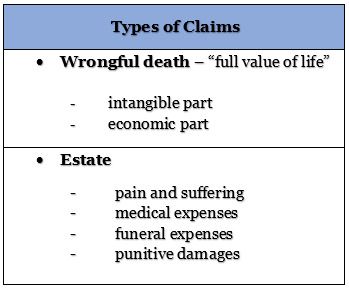
When a person is killed by the wrongful act of another, the person or entity that caused the death must compensate the deceased person’s family for “the full value of the life” of the person who died. O.C.G.A. § 51-4-2(a). Importantly, the “full value of the life” is determined from the perspective of the person who died.
For clients of our firm, there are no up-front costs (and no costs at all if we don’t recover money for the family). In wrongful death cases, as with all personal injury cases that we handle, our firm pays all case expenses out of our own pocket. Those expenses include investigation costs, filing fees, the costs of record requests, deposition costs, expert witness fees, travel, and (if necessary) trial preparation costs. Our firm is reimbursed for those expenses at the end of the case from the money that we recover for the family. If we don’t recover any money, we don’t get paid back and we don’t charge our client.
Most of the time, the answer is two years. That is because the deadline established by the “statute of limitation” for personal injury usually applies to wrongful death cases. See O.C.G.A. § 9-3-33.
However, the applicable deadline could be shorter or longer, depending on the facts. If the deceased died because of something that a government entity did wrong—for instance, if the deceased was killed in a car accident with an employee of the state of Georgia—then a special, additional, earlier deadline known as an “ante litem” deadline could apply. The exact deadline depends on whether the at-fault government entity is a state, county, or city, but the deadline could be six months or a year.
There are cases in which the deadline to bring a wrongful death case is longer than two years. For instance, if one of the people at fault for the death was charged with a crime—or could have been charged with a crime—then the statute of limitation may be “tolled” (i.e., paused) until that prosecution is complete, for a maximum of six years. O.C.G.A. § 9-3-99; Harrison v. McAfee, 338 Ga. App. 393 (2016). After the criminal prosecution is complete or six years have passed, then the two-year clock for bringing a wrongful death starts ticking again.
Georgia law takes wrongful death cases very seriously. When a person is killed by the wrongful act of another, the person or entity that caused the death must compensate the deceased person’s family for “the full value of the life” of the person who died. O.C.G.A. § 51-4-2(a). Importantly, the “full value of the life” is determined from the perspective of the person who died. In other words, the question is what “value” the deceased person placed upon his or her own life. Brock v. Wedincamp, 253 Ga. App. 275, 281-82 (2002).
The “full value of the life” breaks down into two parts under Georgia wrongful death law. The first, and most important part, is called the “intangible” value of a life. This includes the value of time that the deceased person (also known as the “decedent”) spent with family, with friends, or doing things that the decedent liked to do—such as playing sports, hiking, working on cars, sewing, or other hobbies. The intangible value of a life includes the milestones that most of us get the opportunity to experience—such as forming lifelong friendships, falling in love, graduating from high school, earning a first paycheck, asking or being asked for marriage, having children, being promoted, watching children grow up, having grandchildren, or enjoying retirement. If the person died before being able to experience these things, those lost experiences are part of the “full value” of life under Georgia’s wrongful death law.
The second part of the “full value” of a life is economic. This involves the money that the deceased person would have earned, without deductions for taxes or expenses, plus the economic value of services that the deceased person performed, such as mowing the lawn or washing dishes. Where appropriate, the law firm handling a wrongful death case can hire an expert economist to add up how much money the deceased would have made in the remainder of his or her life, and the value of services that the deceased would have performed, and present those figures to the judge and jury.
In addition to a wrongful death claim, when a person dies through the fault of another, the deceased’s family usually also brings an “estate” claim. The estate claim is related to the wrongful death claim, but the compensation that is available is different. Whereas the wrongful death claim is for the “full value of the life” of the deceased, the estate claim allows the deceased person’s heirs or beneficiaries to recover for the pain and suffering that the deceased experienced, for medical expenses, for funeral expenses, and for certain other items of damages.
 Contact Us Now







245 W. Crogan Street
Lawrenceville, GA 30046
Lawrenceville, GA 30046


21 Lee Street, Suite 250
Jonesboro, GA 30236
Jonesboro, GA 30236